PORTALCCTP
PortalCCTP
Launch Application
Open PortalCCTPThe Problem
Cross-chain stablecoin movement is broken. Users face a fragmented landscape of third-party bridges, each with different security assumptions, liquidity constraints, and fee structures. Wrapped assets introduce counterparty risk. Liquidity pools can be drained. Settlement times vary from minutes to hours with no visibility into status.
Moving $10,000 in USDC from Arbitrum to Base should not require trusting an intermediary or accepting a synthetic asset.
The Solution
PortalCCTP builds directly on Circle's Cross-Chain Transfer Protocol v2. This is the only mechanism where USDC is burned on the source chain and minted natively on the destination. No wrapped tokens. No liquidity pools. No third-party custody.
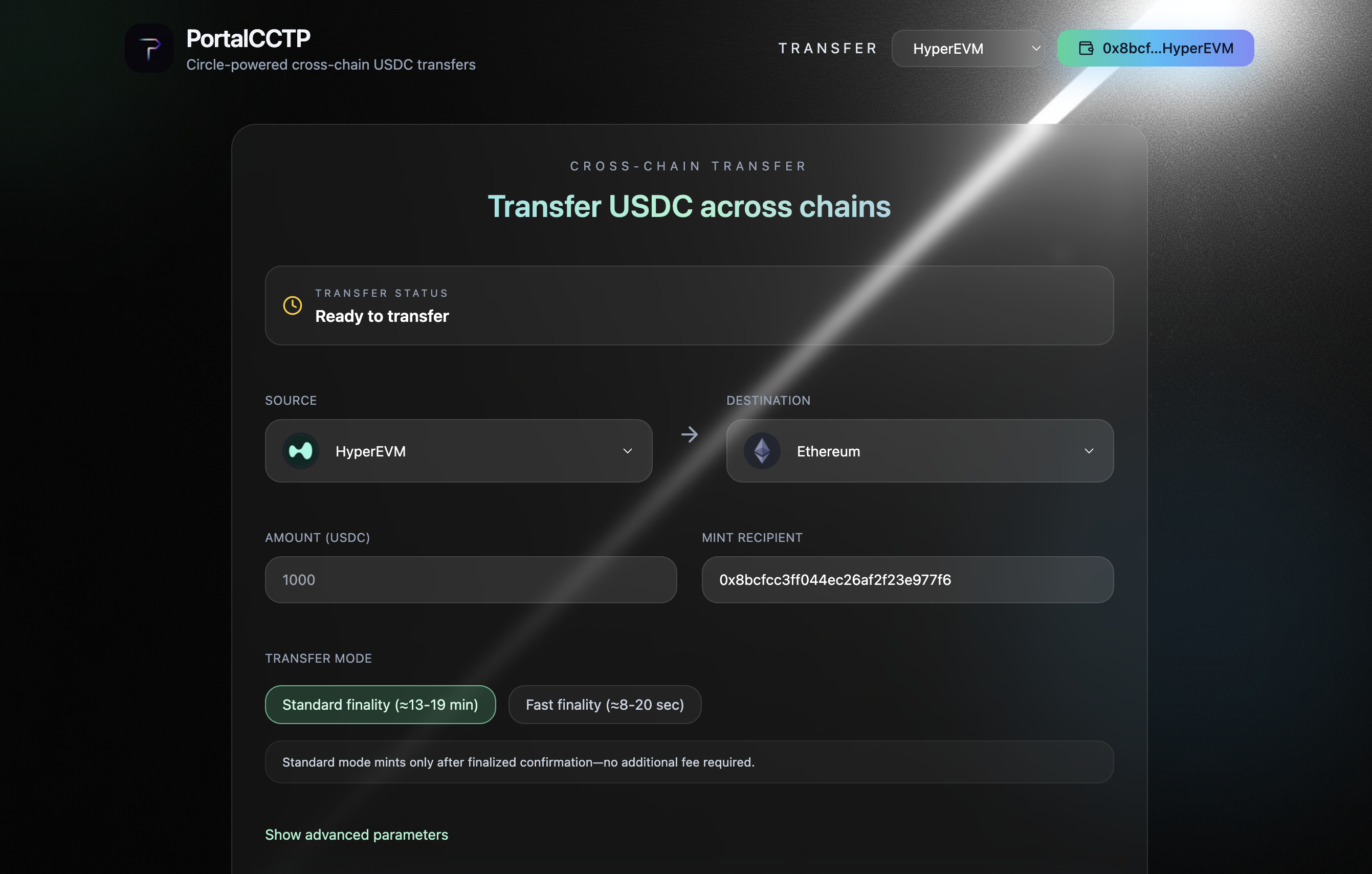
The protocol flow is straightforward: burn USDC on Chain A, wait for Circle's attestation service to sign the message, mint USDC on Chain B. PortalCCTP abstracts these three steps into a single interface with real-time status tracking.
Technical Architecture
Protocol Layer
- Circle CCTP v2 MessageTransmitter and TokenMessenger contracts
- Circle Iris attestation service for cross-chain message verification
- Native burn/mint mechanism (no wrapped or synthetic assets)
Application Layer
- Non-custodial wallet integration (user signs all transactions)
- Automatic network detection and switching prompts
- Transaction indexing for burn/mint correlation
Finality Options
- Fast Mode: Pays priority fee to Circle's relayer network. Settlement in seconds.
- Standard Mode: Waits for natural attestation. Settlement in 10-15 minutes. No additional cost.
Supported Networks
Eleven mainnet deployments:
| Network | Type | CCTP Version |
|---|---|---|
| Ethereum | L1 | v2 |
| Avalanche | L1 | v2 |
| Arbitrum | L2 | v2 |
| Optimism | L2 | v2 |
| Base | L2 | v2 |
| Linea | L2 | v2 |
| Unichain | L2 | v2 |
| Sonic | L1 | v2 |
| World Chain | L2 | v2 |
| Sei | L1 | v2 |
| HyperEVM | L1 | v2 |
Additional networks added as Circle expands CCTP support.
Advanced Configuration
For programmatic integrations and power users:
- Destination Caller: Restrict mint execution to a specific address. Required for mint-and-call patterns.
- Hook Data: Attach arbitrary hex payload to the mint transaction. Enables downstream contract execution.
- Max Fee Override: Set explicit ceiling on fast-mode priority fees.
Security Model
PortalCCTP is a frontend. It does not custody assets, relay transactions, or operate infrastructure.
- All transactions signed locally in user's wallet
- Contract interactions limited to Circle's audited CCTP deployments
- Attestation verification handled by Circle's Iris service
- No backend servers, no API keys, no stored user data
The security boundary is Circle's protocol and the user's wallet. PortalCCTP adds no additional trust assumptions.
Development Status
| Milestone | Target | Status |
|---|---|---|
| Burn/mint on eleven networks | Q3 2025 | ✓ Live |
| Fast finality integration | Q3 2025 | ✓ Live |
| Destination caller + hook fields | Q4 2025 | ✓ Live |
| Re-attestation recovery flow | Q4 2025 | In Progress |
| Attestation timing analytics | Q1 2026 | Planned |
| EURC support | Q2 2026 | Planned |
Usage
- Connect wallet
- Select source chain, destination chain, amount
- Select finality mode (fast/standard)
- Approve USDC spend (first transfer only)
- Execute burn transaction
- Wait for attestation (status displayed in UI)
- Switch to destination network
- Execute mint transaction
Both transaction hashes displayed for verification.